
For people caught up in emergency situations, speedy and sustained humanitarian assistance can be the difference between life and death. To deliver this assistance Islamic Relief relies on a combination of constant vigilance in tracking weather patterns and conflicts, meticulous planning and preparation in vulnerable countries, and swift and decisive action when disaster strikes, in collaboration with partners.
The first 72 hours after a crisis begins, when lives are often most at risk and funding can be limited, are critical. While each emergency is different, Islamic Relief has developed steps to ensure aid reaches people in need as quickly as possible. We quizzed Affan Cheema, Head of International Programmes, on how it’s done.
Q: Is there anything Islamic Relief can do to prepare for a disaster ahead of time?
A: All Islamic Relief country offices develop disaster preparedness plans for emergencies they are likely to face, such as seasonal monsoon flooding in parts of Asia. These plans help inform any response and strengthen readiness for disaster throughout the organisation.
In these plans, offices consider how to support those who may be particularly vulnerable during emergencies, including women and girls, older people and people with disabilities.
Some emergencies, such as cyclones, can increasingly be spotted and tracked before they make landfall, enabling Islamic Relief’s Emergency Panel to meet before the main impact of the disaster in some cases.
Q: How does Islamic Relief find out about emergencies?
A: The Islamic Relief office in the country where the emergency has taken place will typically raise an emergency alert and conduct an initial assessment of the situation and needs on the ground, with the information they have available.
Raising an emergency alert triggers a meeting of Islamic Relief’s Emergency Panel, which usually takes place within 24 hours of a disaster occurring or an alert being received.
Q: What does the Emergency Panel do?
A: The Emergency Panel has an important role in galvanising and coordinating our approach to all emergencies, whatever their scale. It brings together a wide range of specialist staff to assess the situation, agree how Islamic Relief will respond, and allocate resources and decide priorities. I am joined on the panel by international programmes colleagues – including the head of disaster risk management and the relevant head of region and country director – and communications and fundraising representatives.
First, we establish what’s happening on the ground. We do this primarily through input from the Islamic Relief country office where the emergency is occurring, but it’s also important to look at information from partner organisations, the United Nations, and media reports – particularly if we don’t have an Islamic Relief presence in the country concerned. We assess the scale of the emergency and what the most urgent and immediate needs are.
We look at how many people are affected, what the scale of damage is, and what kind of support the country’s government has asked for. We also consider the extent to which we are positioned to contribute to the response, and whether we are going to launch a major fundraising appeal. This is a decision mainly based on the scale of relief operation required to meet the needs of the communities affected, but also on our assessment of how well placed our member offices are to raise significant funds.
We can draw upon two emergency contingency funds to make an initial injection of funding promptly while our fundraising is gearing up. The initial panel meeting is also an opportunity to decide what we are going to say about the situation on our website and on social media and how we will generate and respond to media interest.
Q: What happens after the Emergency Panel meets?
A: The initial panel meeting is only the beginning of Islamic Relief’s response, particularly in the case of larger emergencies. What follows for these will include a global telephone conference for Islamic Relief member offices within 72 hours, daily emergency coordination meetings for at least a week – and sometimes months – regular humanitarian update emails, and the development of three-month, six-month, and longer-term relief and recovery plans.
We recognise that it is not only what happens during an emergency that counts, but also what Islamic Relief puts in place before and after to prepare communities and rebuild livelihoods, to learn lessons and strengthen disaster resilience in the long term.
Q: What happens when an emergency strikes in a country where Islamic Relief has no presence?
A: To reach people in countries vulnerable to disaster in which we do not have a presence, Islamic Relief does not wait until the worst happens. We proactively forge partnerships with organisations based in those countries – so when emergencies happen, we can respond promptly through established partnerships. Not only is this more effective than trying to find new partners in the wake of a disaster, this approach also aligns with the Grand Bargain 2.0, to which Islamic Relief is committed, by investing more in developing the capacity and capability of local organisations to meet local needs.
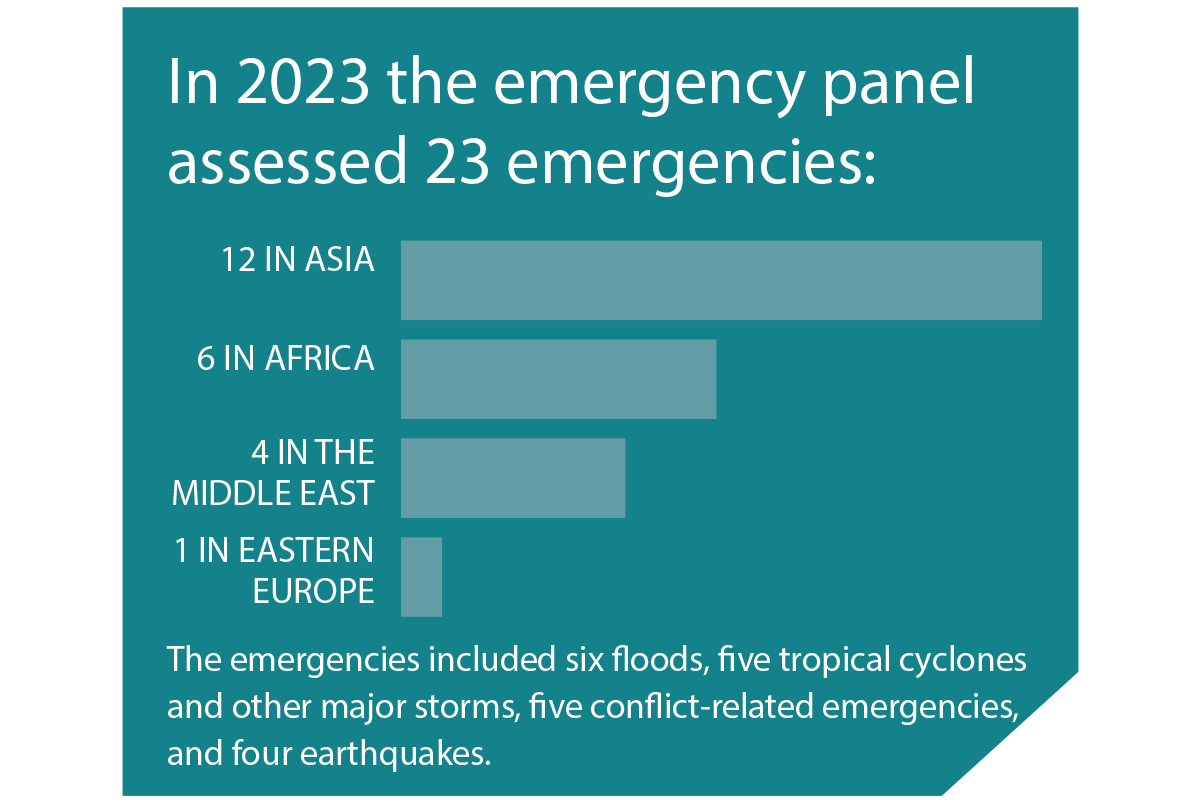
Islamic Relief responded to an unprecedented number of large-scale emergencies that struck in 2023:
FEBRUARY: TÜRKIYE-SYRIA EARTHQUAKE
APRIL: SUDAN CRISIS
SEPTEMBER: MOROCCO EARTHQUAKE AND LIBYA FLOODS
OCTOBER: GAZA ESCALATION
These emergencies saw the global Islamic Relief family work together to respond at scale to the needs of those affected.
In our immediate response, Islamic Relief always takes steps to ensure we’re meeting the most pressing needs of survivors, such as:
FOOD: FOOD PARCELS, VOUCHERS, AND CASH
WATER: CLEAN DRINKING WATER
SHELTER: TENTS, PLASTIC SHEETING, FUEL AND WARM CLOTHING
HEALTH AND HYGIENE: SOAP, BUCKETS FOR WASHING, MEDICINE AND MOBILE HEALTH FACILITIES.