
Islamic Relief Worldwide is an international humanitarian organisation made up of a lot of moving parts. We believe transparency about how the organisation is run is vital to our long-term success and that a better understanding of Islamic Relief’s governance can help us to build stronger ties with donors, banks, other humanitarian organisations, and authorities in the countries where we operate, enabling us to reach even more people in need. Javed Akhtar, Finance and Corporate Services Director, explains how Islamic Relief’s governing bodies work together make our work possible.
Q: Islamic Relief is a large organisation, operating in many different countries and contexts. How is it run?
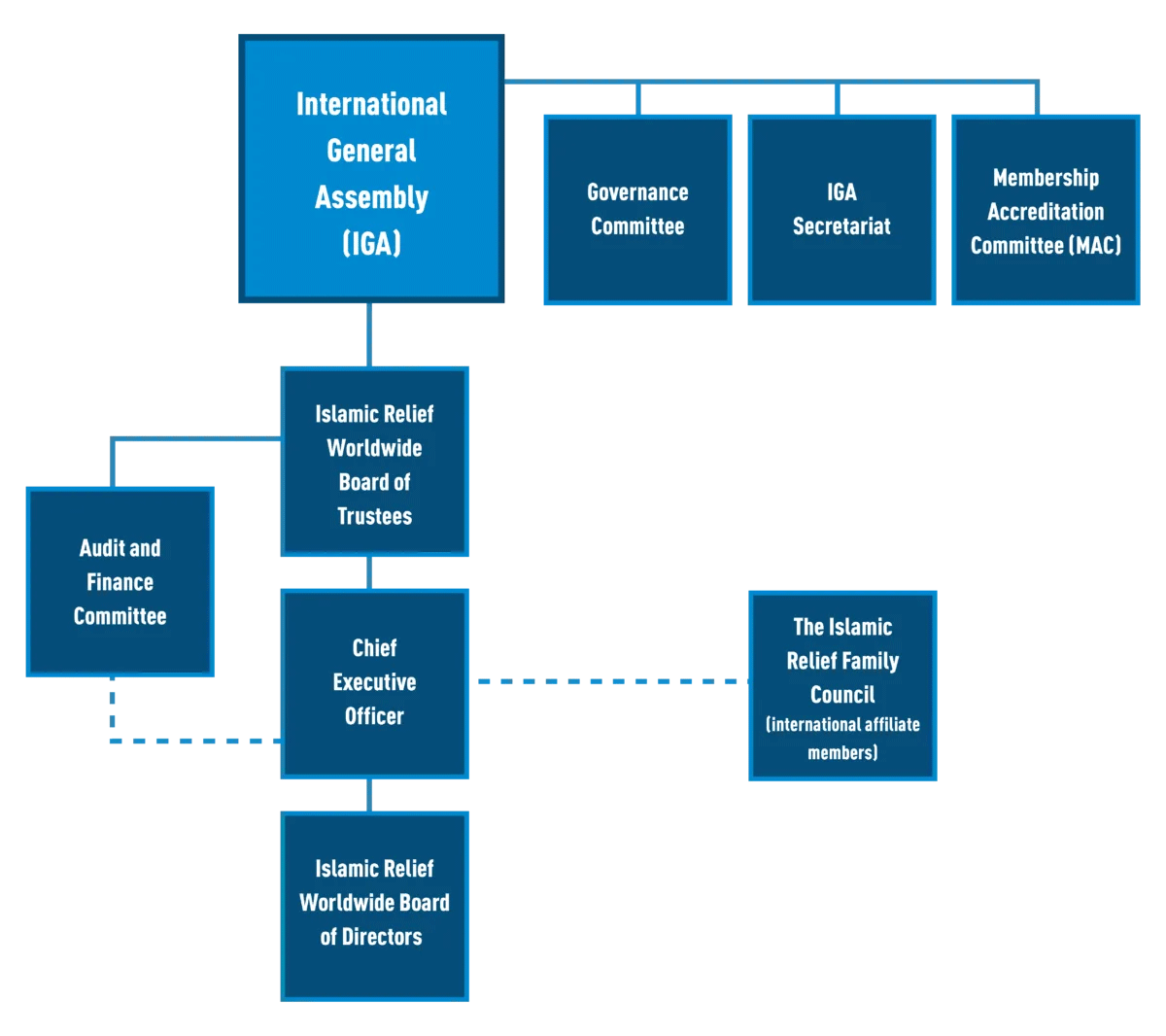
A: Let’s start at the very top. The highest body of the Islamic Relief Worldwide governance structure is our International General Assembly (IGA), which has been in operation since 2020.
It was introduced to help address the changing needs of the Islamic Relief family, as well as the challenging environment in which we operate, and is made up of representatives from and elected by Islamic Relief member offices.
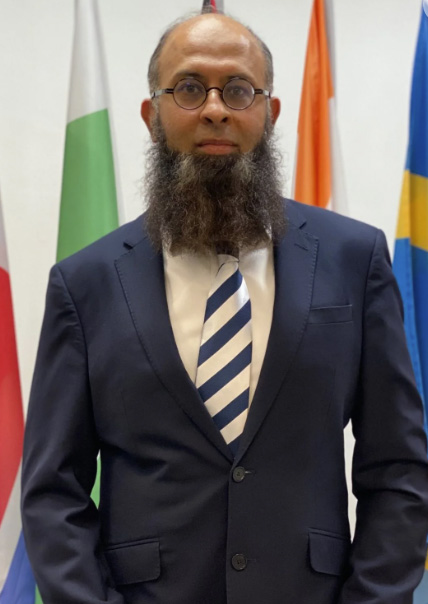
Javed Akhtar,
Finance and Corporate Services Director
Ultimately, we want up to one third of the IGA to be independent members from outside the Islamic Relief family who can contribute specialist skills and experience. Independent members will also increase the diversity and accountability of the IGA.
Q: What does the IGA do in practical terms?
A: The IGA has five main responsibilities, these are:
- electing members of the IGA to Islamic Relief Worldwide’s Board of Trustees
- approving any changes to Islamic Relief Worldwide’s governing documents, member policies and mission strategy, as well as being the final arbitrator on issues of membership
- appointing the Chair and members of the Membership Accreditation Committee (MAC)
- appointing the Chair of the Governance Committee, which is responsible for proposing best practices across the Islamic Relief family. It also reports on adherence to agreed standards, policies and procedures across all member offices.
Q: You’ve mentioned a few other governing bodies there. Can you tell us more about Islamic Relief’s Board of Trustees?
A: As I mentioned, the Board of Trustees is elected by the IGA, with each trustee term lasting four years. The Board is diverse and made up of trustees – five men and four women – from eight countries across five continents.
Each trustee is a volunteer that brings different skills, knowledge and experience that together will help Islamic Relief to develop and respond to key challenges.
In practical terms, the Board’s main responsibilities are:
- overseeing the governance of Islamic Relief Worldwide in accordance with our statutory obligations, making sure we satisfy our regulatory requirements
- acting always in a manner most likely to support the charity in meeting our aims and objectives
- overseeing the development of the organisational strategy and the setting of priorities and objectives
- approving the executive management structure of the organisation together with delegated authorities
- evaluating performance and progress
- approving relevant new policies and procedures
- appointing the CEO, evaluating the performance of the executive management team and making appointments to, and dismissals from, this team
- approving the remuneration policy of the organisation and setting the remuneration for senior management.
Q: How does Islamic Relief help prepare trustees for their important role?
A: We recognise that the responsibilities of trustees can be extremely challenging due to the scale and complexity of the organisation. To help them fulfil their duties to the best of their abilities each new trustee is assigned a mentor and receives a comprehensive induction.
This includes a full overview of our strategic and operational functions, as well as a welcome pack, which includes a copy of the Memorandum and Articles of Association, the financial statements, Board minutes, the Charity Commission guidance ‘The Essential Trustee’ and recent publications.
We also actively encourage trustees to identify any training they may need, and our CEO keeps them up to date with training opportunities and changes in regulatory standards. We continually evaluate the Board’s effectiveness. The Board of Trustees receives regular performance reports, annual financial reports, plans and budgets. The Board is committed to continuous improvement and will soon put in place a periodic third-party review and assessment of its effectiveness and its way of working.
Islamic Relief provides training for our trustees to inform them of the key areas they need to know about to carry out their duties and responsibilities effectively and efficiently. We also train Board members and executives, drawing on their experience to strengthen their understanding and application of governance principles in line with best practice.
Q: How does the Family Council fit into the governance structure?
A: Alongside the IGA, we also have a global executive branch, which is known as the Islamic Relief Family Council.
This is a forum that brings together the chief executives of Islamic Relief Worldwide and all Islamic Relief member entities to enhance communication, strengthen relationships and provide strategic insight to help improve processes within Islamic Relief Worldwide itself and the wider federation of members.
Q: What about the Membership Accreditation Committee?
A: The Membership Accreditation Committee (MAC) is a permanent committee of the Islamic Relief Worldwide General Assembly (IGA), which reports to the IGA and coordinates with the Board of Trustees. The main purpose of the MAC is making recommendations on the suitability of members (both entities and individuals) to the IGA.
These recommendations can potentially include the initial nomination, membership levels, renewals and ending membership. The MAC ensures adherence to the rules governing membership of the IGA and the Board of Trustees.
Q: You mentioned the IGA also appoints the Chair of the Governance Committee. What does this Committee do?
A: The Governance Committee helps to identify best practice for all Islamic Relief entities and ensure compliance with agreed standards, policies and systems throughout the organisation.
Q: The last body I wanted to ask about is the Audit and Finance Committee. What are its responsibilities?
A: The main purpose of the Audit and Finance Committee is to provide oversight of the financial reporting process, the audit process (internal and external), our system of internal controls, risk management and compliance with laws and regulations.
Q: Where do individuals like the CEO of Islamic Relief Worldwide fit into what you’ve just described?
A: The chief executive officer (CEO) is accountable to the Board of Trustees and, along with other senior staff, is responsible for our day-to-day management.
The CEO chairs the executive management team, which is made up of directors, like myself. These divisional directors make sure that the policies and strategies agreed by the Board of Trustees are implemented, and we also support the work of other staff and volunteers.
Our Delegation of Authority Policy authorises staff, according to our position and specialist knowledge, to be accountable and responsible for implementing Islamic Relief’s objectives. Every decision we make must adhere to all of our policies, processes, and guidelines. The Audit and Finance Committee periodically review the delegation of authority matrix.
A full list of trustees and key personnel is given in the corporate directory on pages 101 and 102.
Q: How does Islamic Relief recruit for these roles?
A: We strive to attract and retain talented individuals based on their passion, commitment, values, knowledge, skills and experience. While the financial dimension is not the foremost basis for engagement, we are keen to pay our team appropriate salaries. As such, our remuneration principle is to be market relevant, not market driven – so we position ourselves in the median quartile of benchmarking exercises.
Our remuneration model is designed to be cost effective and sustainable, and in line with our determination to be ‘lean’ to maximise the amount we spend on our programme work. All staff received a three per cent cost of living increase from 1 January 2023. We also gave an additional one step (three per cent) incremental increase to staff who met the criteria following their annual performance appraisal from 1 April 2023. We are currently undertaking a benchmarking exercise and will consider the recommendations from this review in 2024.
We recognise that attracting and retaining the best talent requires sufficient flexibility to allow for a case-by-case consideration for particularly exceptional talents, hard-to-fill roles and top performers. By using the steps within a set grade range, we can apply this flexibility while maintaining the integrity of the wider grading system. We also encourage and reward opportunities for acting up and secondments within the charity to allow colleagues to learn and develop valuable skills and experience.
Q: Earlier, you mentioned Islamic Relief Worldwide’s ‘governing documents’. Can you tell us a bit more?
A: Governing documents is an umbrella term for the documents that define what Islamic Relief is and what we do.
When we’re talking about ‘Islamic Relief’ or ‘Islamic Relief Worldwide’, we’re referring to the charity incorporated as a company limited by guarantee in England and Wales. Our governing document, known as Memorandum and Articles, was originally dated 14 March 1989 and amended on 9 August 2010 and the Objects amended on 16 March 2020 to reflect the education, advocacy and broader work of Islamic Relief Worldwide rather than just the original goal of ‘alleviation of poverty.’ Islamic Relief Worldwide is registered with the Charity Commission of England and Wales and with the Office of the Scottish Charity Regulator.
Other pertinent documents that are now in place with the implementation of the new governance structure and the establishment of the IGA are:
Licence Agreement: the document that confirms that Islamic Relief members can use the Islamic Relief name and logo in their respective geographical areas
Members Agreement: a contractual agreement between Islamic Relief members and Islamic Relief Worldwide that cements and defines the terms of our mutually beneficial relationship.
Q: I’ve heard Islamic Relief has some subsidiaries, what can you tell us about them?
A: Islamic Relief has two subsidiaries – TIC International and the International Waqf Fund.
TIC International is a trading subsidiary of Islamic Relief Worldwide, which supports our fundraising activities by recycling clothes and running charity shops across the UK. Its registered address is: TIC International Ltd, 19 Rea Street South, Birmingham B5 6LB.
The International Waqf Fund is also a registered charity. It undertakes waqf (Islamic endowment) activities. Islamic Relief exercises control over the International Waqf Fund, having the right to appoint and remove its trustees. Its registered address is: International Waqf Fund, 22 Sampson Road North, Birmingham B11 1BL.
Q: Within the Islamic Relief family, Islamic Relief Mauritius has a special status
A: Yes, Islamic Relief Mauritius is incorporated as a branch of Islamic Relief Worldwide with local directors appointed to oversee operations.
The entity’s transactions and balances are included within the accounts of Islamic Relief Worldwide.
You can see a full breakdown of Islamic Relief’s global family and its various branches on page 63.